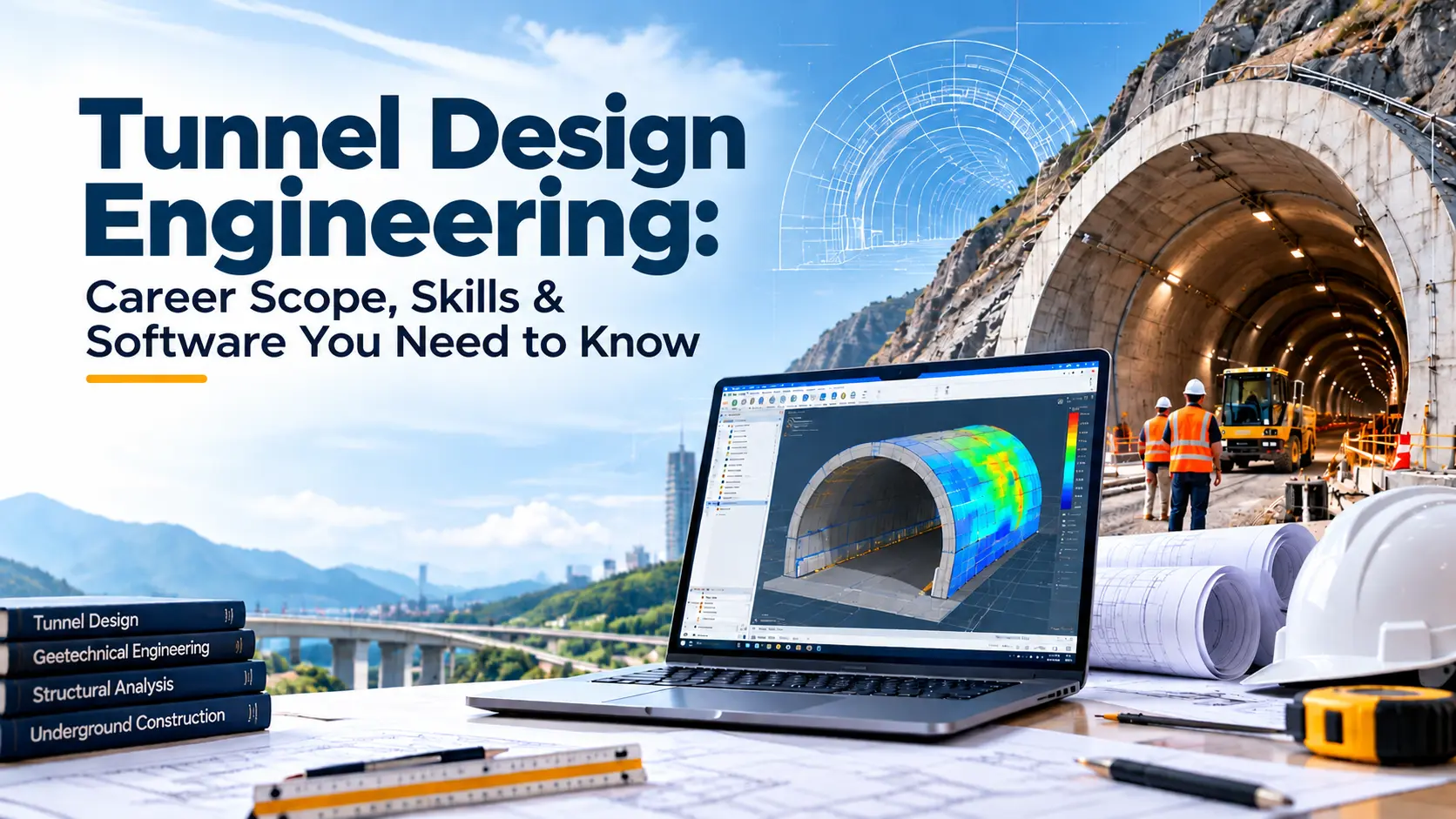
- Introduction
- What Is Tunnel Design Engineering?
- Why is Tunnel Design Engineering Important?
- What Factors are Considered When Designing a Tunnel?
- Which Tunnel Method Is Commonly Used in Different Countries?
- Essential Skills for Tunnel Design Engineers
- Which software is required for Tunnel Designing Work?
- How to Build a Career in Tunnel Design Engineering
- Conclusion
- FAQs
Introduction
The development of metro systems, bridges, highways, hydroelectric projects, and underground utilities calls for well-designed and well-constructed tunnels. This has given rise to the importance of tunnel engineers and tunnel designers.
In addition to a strong grasp of civil engineering principles, one must understand geotechnical and structural analysis. This blog discusses tunnel engineering as a career, the skills necessary for the profession, the most commonly used tunnel design techniques, and software used in the industry.
What Is Tunnel Design Engineering?
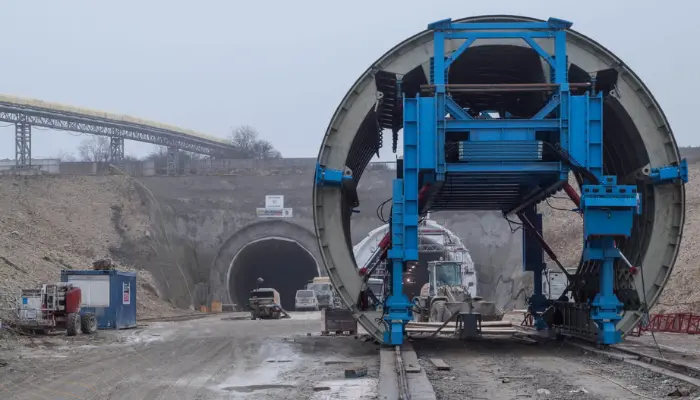
Tunnel design engineering is a specialized branch of civil and geotechnical engineering. It is mainly focused on planning and designing structures found underground that must be safe, stable, and functional.
Tunnel design engineering involves the process of planning and designing tunnels so that they are safe, stable, and fit for their intended purpose. It studies soil, rock, groundwater level, and other geological conditions to determine the tunnel’s alignment, tunneling equipment, and overall design plan.
All in all, tunnel design engineering allows engineers to predict ground behavior during construction and design tunnels that are safe and long-lasting.
Why is Tunnel Design Engineering Important?
A tunnel must withstand loads from the surrounding soil or rock while also accommodating groundwater pressure, construction stresses, traffic and other operational loads, and changes in ground conditions. Poor design can lead to excessive ground deformation, water ingress, instability, or damage to the tunnel lining and surrounding structures.
What Factors are Considered When Designing a Tunnel?
Tunnel design is influenced by both the tunnel’s intended use and the conditions through which it will be constructed. Engineers focus on:
- Geology and ground conditions: Soil and rock type, rock mass quality, faults, fractures, and geological formations influence excavation and support requirements.
- Groundwater conditions: Groundwater pressure and seepage reduce the risk of instability.
- Tunnel purpose: Road, railway, metro, water, utility, and mining tunnels have different dimensional, structural, and operational requirements.
- Construction method: The selected excavation method influences tunnel geometry, support systems, excavation sequence, and construction equipment.
- Surrounding structures: In urban areas, engineers must consider nearby buildings, roads, utilities, and existing underground structures to control ground movement.
- Safety and operational requirements: Design must account for emergency access, ventilation, drainage, fire protection, lighting, and evacuation requirements.
How Are Tunnel Cross Sections Designed?
Tunnel cross-section design involves balancing functional requirements, structural stability, ground conditions, and the selected construction method. Engineers study the tunnel’s shape and dimensions to ensure adequate space for its intended use while safely resisting ground and water pressures.
Main factors for designing a tunnel cross-section are,
- Function requirements: The cross-section must provide sufficient clearance for vehicles, trains, pedestrians, and equipment. Space is also required for ventilation, drainage, lighting, utilities, and emergency walkways.
- Tunnel shape: Circular shapes are common and effective for uniform ground and water pressure.
- Ground and structural loads: Engineers study ground pressure, groundwater, stress redistribution, and deformation.
- Lining and support: The design determines the required support and lining, such as shotcrete, rock bolts, cast-in-place concrete, or precast concrete segments.
- Construction method: The cross-section must suit the excavation method. Conventional tunnels may be excavated in stages, while TBMs generally require a circular profile. Additional space may be provided for support systems, lining, waterproofing, and construction tolerances.
Which Tunnel Method Is Commonly Used in Different Countries?
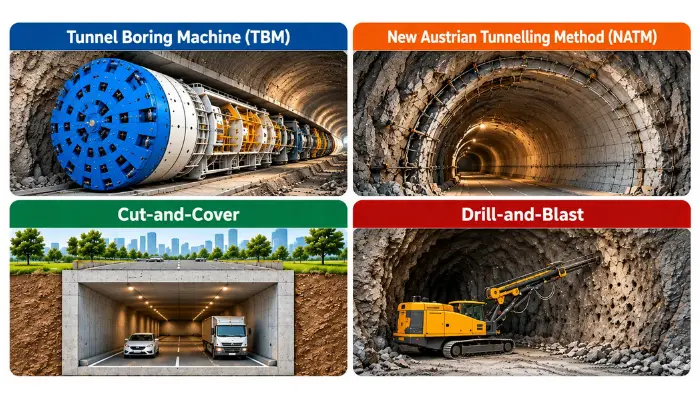
The choice of a tunnel method depends on factors such as ground conditions, tunnel depth, length, geology, groundwater, surface constraints, and project requirements. The most widely used methods include TBM, NATM, cut-and-cover, and drill-and-blast.
- Tunnel Boring Machine (TBM): TBMs use a rotating cutterhead to excavate tunnels mechanically while providing support and, where applicable, installing the tunnel lining. They are used for long metro, railway, road, and water tunnels. TBMs are extensively used in countries such as China, Japan, India, and several European countries. For example, the Mumbai–Ahmedabad Bullet Train project is using TBMs for 16 km of its 21 km underground section.
- New Austrian Tunnelling Method (NATM): NATM uses staged excavation and systematic support, optimizing the surrounding ground to contribute to tunnel stability. It is particularly useful in mountainous and variable geological conditions, including the Himalayas in India. NATM is implemented using the drill-and-blast method, where controlled blasting is used to excavate the tunnel in stages.
- Drill-and-blast: This method uses drilling and controlled blasting to excavate hard rock. It is commonly used in mountainous and rugged terrain, particularly for road, railway, hydro-power, and other infrastructure tunnels. For example, several Himalayan and mountain tunnel projects in India use NATM with controlled drilling and blasting.
- Cut-and-cover: This method involves excavating from the surface, constructing the tunnel structure, and then covering the excavation. It is mainly suited to shallow urban tunnels, metro sections, and underground structures where surface excavation is practical.
Understanding these methods helps engineers select suitable excavation and support approaches for different tunnel projects.
Read More: Finite Element Analysis and Methods for Geotechnical Engineering
Essential Skills for Tunnel Design Engineers
A successful tunnel design engineer needs a combination of design software expertise, analytical skills, and strong theoretical knowledge to develop safe and practical tunnel designs.
- Software Knowledge: First, you have to develop proficiency in software tools like PLAXIS 2D/3D, Rocscience, FLAC3D, MIDAS GTS NX, and CAD to model ground conditions, simulate excavation, analyse tunnel behaviour, and evaluate support systems.
- Data Interpretation: Start by understanding and interpreting geological, geotechnical, and site investigation data to understand ground conditions and make appropriate design decisions.
- Ground-Structure Interaction: Understand how the surrounding soil or rock interacts with the tunnel, lining, and support systems during and after excavation.
- Rock-Mass Classification: Learn systems such as RMR, Q-system, and GSI to assess rock-mass quality and determine suitable excavation and support requirements.
- Geotechnical and Structural Knowledge: Build a strong foundation in soil mechanics, rock mechanics, groundwater behaviour, structural analysis, and tunnel lining design to support safe design decisions.
Which software is required for Tunnel Designing Work?
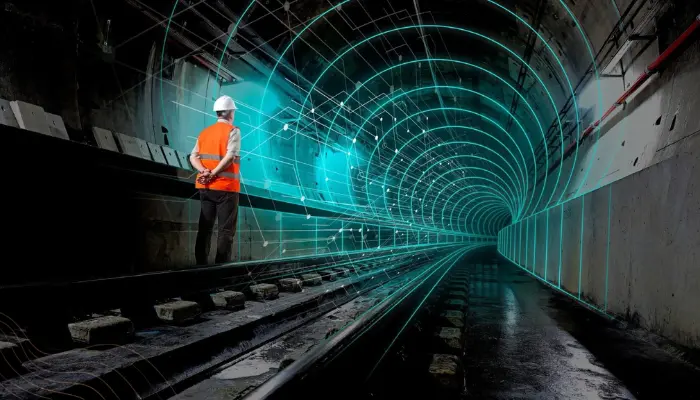
With modern tunnel design, there is a need for engineers who bring skills and knowledge that combine geotechnical analysis, numerical modelling, CAD, and BIM tools to develop accurate and safe underground structures. The following software is commonly used across different stages of tunnel engineering:
- PLAXIS 2D/3D: PLAXIS 2D/3D is a finite element software used for geotechnical analysis and design for underground structures. For tunnel projects, engineers can use PLAXIS to model tunnel excavation sequences and analyse ground deformation, stresses, and stability. PLAXIS 2D is useful for analysing problems which are presented in 2 dimensions, while PLAXIS 3D helps engineers to model more complex three-dimensional tunnel geometries.
- Rocscience 2D/3D: Rocscience provides a range of software tools. It is particularly relevant for tunnel projects where engineers can understand rock mass behaviour, excavation stability, reinforcement, etc. Tools such as RS2 and RS3 are used for two-dimensional and three-dimensional finite element analysis.
- FLAC3D: FLAC3D is a three-dimensional numerical modelling software used to study the behaviour of soil and rock in complex geotechnical engineering problems. It uses numerical methods to simulate how ground materials respond to excavation, loading, support, and other engineering changes.
- MIDAS GTS NX: MIDAS GTS NX is a geotechnical analysis software designed for modelling complex ground and structural interaction problems. It provides tools for finite element analysis, excavation simulation, tunnel analysis, seepage, and ground-structure interaction. In tunnel projects, engineers can create numerical models of the ground and tunnel structure, simulate excavation stages, and evaluate factors such as ground deformation, stress distribution, tunnel stability, and the effects of construction sequences. Its 3D modelling capabilities are useful for analysing complex tunnel geometries and underground construction conditions.
Learning these tools alongside tunnel engineering fundamentals can help engineers develop practical skills for careers in tunnel design and infrastructure projects.
How to Build a Career in Tunnel Design Engineering
To build a successful and steady career in tunnel design engineering, follow these practical, action-oriented, structured learning steps to improve your project experience and career.
- Strengthen your civil and geotechnical engineering concepts: Start by revising the concepts of soil mechanics, rock mechanics, foundation engineering, etc
- Learn the fundamentals of tunnel design: You must study different tunnelling methods, ground conditions, and excavation techniques to understand how tunnels are planned and constructed
- Learn about CAD and engineering tools: Build the ability to create and interpret engineering models
- Apply your skills to real-world tunnel projects: Start working on case studies, sample projects, ground behaviour analysis, and select a suitable support system to interpret design results.
- Take a specialised tunnel engineering course: Enrol in a structured online or professional training programme to learn from industry experts, work on practical projects, and strengthen the skills required for a career in tunnel design engineering.
Career Scope in Tunnel Engineering
The expansion of metros, highways, railways, hydro-power, and underground infrastructure is creating opportunities for professionals with tunnel and geotechnical expertise. Career paths can include tunnel design engineer, geotechnical engineer, structural engineer, project engineer, and construction engineer.
Professionals can work across construction and EPC companies, transportation and infrastructure firms, consulting organisations, water projects, and government infrastructure projects.
Conclusion
Tunnel engineering is a growing field, and it brings opportunities not only at home but also abroad. Nowadays, with so many resources and access to knowledge, building a career in tunnel design is easy and commendable. If you have a strong foundation in civil, structural, and geotechnical engineering, along with knowledge of soil and rock mechanics and construction methods, it is easy to become a tunnel engineer.
To sharpen your skills, improve your software knowledge, and gain real-world experience, you can enroll in online courses like PIGSO LEARNING, where you can develop industry-relevant skills and work toward becoming a certified engineer. You can also explore their Tunnel Engineering Course to learn practical tunnel design and analysis skills.
FAQs
What is tunnel engineering?
Tunnel engineering is a specialized branch of civil and geotechnical engineering focused on planning, analysing, designing, constructing, and maintaining underground structures
What is tunnel design?
Tunnel design is the process of planning the alignment, dimensions, and other structural requirements based on ground and project conditions. In short, designing a metro tunnel by assessing soil conditions, groundwater levels, tunnel depth, and structural support requirements before construction begins.
What are the main tunnel design methods?
The main tunnel design and construction methods are cut-and-cover, Tunnel Boring Machine (TBM), and New Austrian Tunnelling Method (NATM).
Which software is used for tunnel design?
PLAXIS 2D/3D, RocScience 2D/3D, FLAC3D, and MIDAS GTS NX. These tools support different aspects of tunnel engineering, such as geotechnical analysis, numerical modelling, tunnel excavation simulations, 2D drafting, and 3D modelling.
What skills are required for tunnel design?
Skills include core engineering knowledge, insights into geotechnical-structural analysis, soil and rock mechanics, numerical modelling, and CAD and FEA software proficiency to ensure safe and stable underground structures.

Simran Shekhawat is an experienced SEO content writer with three years of hands-on experience in crafting high-impact digital content. With a strong command of search engine optimisation practices, she specialises in creating content that not only reads well but also ranks effectively. Her expertise encompasses keyword research, topic clustering, on-page SEO, content strategy, and crafting copy that aligns with both user intent and brand objectives.
Comments are closed