How Geotechncial FEA Software works and why it’s important to use?
Learning about geotechnical finite element Analysis (FEA) software works by breaking down complex soil and rock masses into small elements, simulating how they behave under real-world loads, excavations, and groundwater conditions.
With time, engineers have developed input material properties, boundary conditions, and construction stages, where the software calculates stress, deformation, and failure patterns across the entire model.
Some of the exceptional tools, like PLAXIS and Rocscience RS2, are built specifically for this purpose. The PLAXIS helps provide detailed guidance on setting up soil models, defining drainage conditions, and interpreting results for civil infrastructure design, while Rocscience RS2 applies the same finite element principles to rock masses, underground excavations, and mining environments.
What is PLAXIS Geotechnical Software?
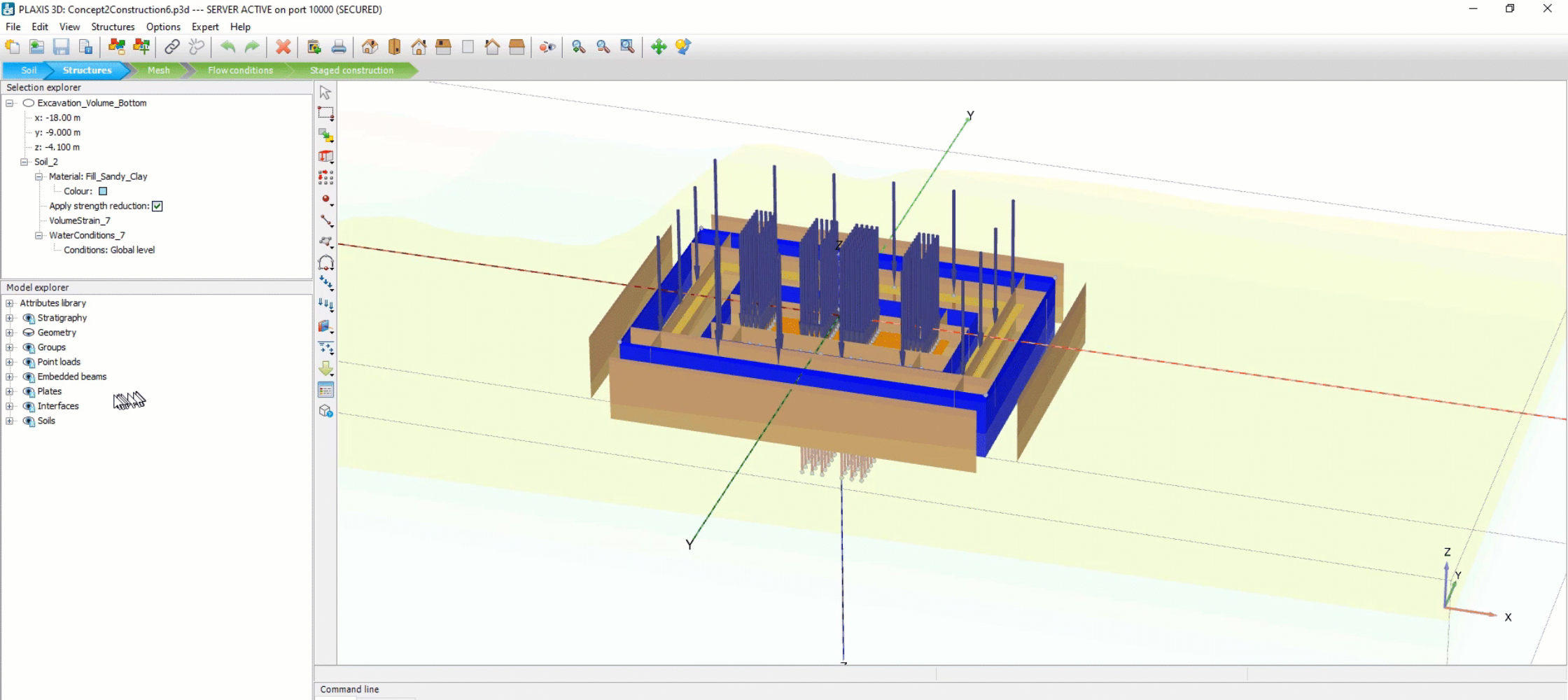
Plaxis is a computer program that performs finite element analyses within the realm of geotechnical engineering, including deformation, stability, and water flow. The input procedures enable the enhanced output facilities to provide a detailed presentation of computational results.
What is Rocscience Software?
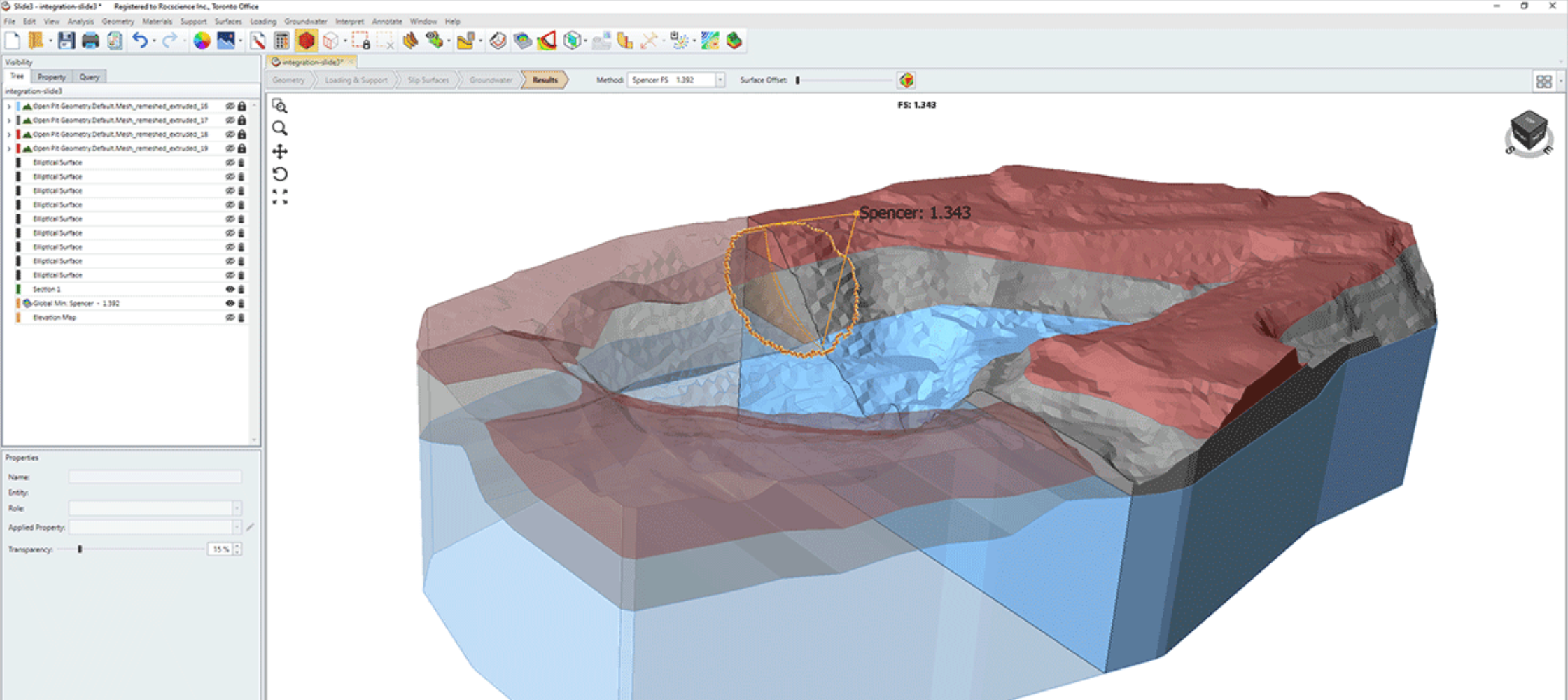
Rocscience is known to be a leading geotechnical software provider specializing in rock and soil mechanics analysis. It is used for understanding tunnels, slopes, excavations, and underground structures. Plus, it is also used in mining and rock engineering systems.
PLAXIS vs Rocscience: Key Comparison
Understanding the Features of PLAXIS and Rocscience
| Feature | PLAXIS | Rocscience |
| Developer | Developed by Bentley systems being is a leading solution for advanced soil and infrastructure analysis using PLAXIS geotechnical software. | Rocscience was founded in 1996 by Dr. John Curran, a professor at the University of Toronto who led the school’s Rock Engineering Group. |
| Method | Uses the FEA – Finite Element Method, which creates a detailed model for soil deformation, settlement, and stability analysis | Also uses the Finite Element Method for analyzing rock stability, tunnels, and excavation performance. |
| Focus | Primarily focused on soil mechanics and soil structure interaction. Engineers use guidance from the PLAXIS manual and the material models manual for accurate soil simulation. | Focuses on rock and soil mechanics, with strong capabilities in rock mass analysis and reinforcement, including geosynthetic,s RS2 Rocscience applications. |
| Best Use | Best suited for civil engineering and infrastructure projects. It also supports deep excavations, deformation analysis, slope stability assessments, dam engineering, retaining wall design, tunneling, and liquefaction studies. Real-world projects where PLAXIS has been actively used include: Golder Associates with Subsea TBM Tunnel, in which the PLAXIS model was used to strengthen one of the world’s largest subsea TBM tunnels. SAIDEL Engineering – Residential Building over Subway Tunnels, Bucharest, where PLAXIS provided the industry model to assess and approve the construction of a residential building directly above West Bucharest’s subway tunnels, enabling safe future urban development in the area | Best suited for mining, tunneling, and underground rock engineering projects using Rocscience RS2. Real world scenario where RS2 has been used, Melbourne Metro tunnel, Australia. It was used to stimulate excavation conditions and assesses settlements risk for a 9km tunnel project Garhwal Himalaya Adit tunnel, India, where Rs2 validates the support system designs for the 672-meter tunnel over the complex Himalayan terrain. |
Difference Between PLAXIS and Rocscience
To know the difference between PLAXIS and Rocscience is that their focus and application are different in geotechnical engineering.
PLAXIS geotechnical software is designed by PLAXIS Bentley and is mainly used for soil mechanics and infrastructural projects, while under PLAXIS 2D software, engineers try to create accurate PLAXIS models to analyze foundations, slopes, tunnels, and soil with structure interaction.
In contrast, Rocscience is more focused on rock mechanics and underground engineering. Rocscience RS2 is widely used for rock stability analysis, tunnel design, mining projects, and reinforcement applications such as geosynthetics RS2 Rocscience. It provides efficient tools for analyzing rock mass behavior and excavation performance.
In summary, PLAXIS geotechnical software is best suited for soil analysis and civil infrastructure, while Rocscience RS2 is better suited for rock engineering and mining-related geotechnical analysis.
Read More: PLAXIS Software In Geotechnical Engineering: A Complete Overview
Which Software is Better: PLAXIS or Rocscience?
It is found that both PLAXIS geotechnical software and Roscscience tools are bound to be powerful because of the finite element analysis solutions they deliver.
The right choice between the two depends entirely upon the project requirements and overall engineering focus.
PLAXIS Bentley is used in civil and infrastructural engineering areas where there is a need for accurate soil simulations, whereas the Rocscience RS2 is used in rock mechanics and mining applications.
Choose PLAXIS when:
- To conduct an advanced soil simulation with detailed parameters to get realistic results.
- Choose PLAXIS when you are doing civil infrastructure projects to dominate your work. As it helps in designing foundations, embankments, retaining walls, sheet pile walls, and basement excavations, where soil-structure interaction is the primary concern, with the help of PLAXIS 2D and 3D
- You can use PLAXIS when you are working on soft ground tunneling.
- Using PLAXIS when your project involves staged construction, as PLAXIS handles time-dependent loading sequences, dewatering stages, and phased excavations with high accuracy, which is critical for urban construction sites.s
- You can choose PLAXIS when your work is for civil engineering projects like tunnels or retaining walls, where the PLAXIS 2D/3D software helps provide precise soil structures.
- When predicting long-term settlements beneath structures on compressible soils, such as reclaimed land or marine clay sites, you can use PLAXIS.
Choose Rocscience when:
- You want to work primarily on mining, tunneling, or any rock engineering projects.
- Use Rocscience RS2 when you want an efficient tool for understanding rock mass behaviour, or want to study underground excavations and reinforcement systems.
- Using Rocscience when your project is mining or hard rock excavation. As Rocscience RS2/RS3 is the go-to for open-pit slope stability, underground stope design, and mine pillar analysis in competent rock
- Using Rocscience for designing underground rock tunnels. For drill-and-blast or TBM tunnels, RS2 provides efficient tools for support design, including rock bolts, shotcrete liners, and steel sets.
- You can also use Rocscience tools to build GSI, RMR, and Q-system inputs, making them useful when your site investigation is rock-focused
| Factor | Use PLAXIS | Use Rocscience |
|---|---|---|
| For primary material | Soil and mixed ground | Rock and hard ground |
| Mainly used for project type | Geotechnical engineering involves soil mechanics, deformation, stability, groundwater flow analysis, tunneling, and deep excavations | Geotechnical engineering involves rock mechanics Mining, tunnel, Rockfall Hazards, foundations and excavations, and slope stability |
| Analysis Depth | Advanced FEM | FEM + Limit Equilibrium (rock focus) |
| Typical deliverable | Settlement, thermal analysis, liquefaction, post-seismic deformation, and slope stability provide a wider range of outputs. | Stability and support design reports |
| Industry demands | Civil and infrastructure, Rail, road, and port buildings | Mining, quarrying, and tunnels in rock |
Benefits of using PLAXIS Bentley Software
- Industry-Standard Geotechnical Software
PLAXIS geotechnical software is known to have an industry standard for civil and geotechnical engineers worldwide.
Being developed by Bentley Systems, it is used by engineering companies, researchers, and infrastructure professionals for advanced soil analysis and design. As engineers rely on PLAXIS software to create a realistic PLAXIS model that simulates real-world ground conditions, helping improve project safety and performance.
- Accurate Simulation Results
Another advantage of PLAXIS Bentley is its ability to deliver highly accurate simulation results. While using the advanced finite element analysis, engineers can now predict the soil deformation, settlement, and stress distribution under different loading conditions.
PLAXIS, as a software, allows engineers to define soil properties well while using the static guidelines from the material models, while ensuring realistic behaviours of soil structural elements.
To achieve this level of accuracy, engineers are required to make informed decisions while minimizing risks in construction and infrastructure projects. With advanced modelling capabilities, PLAXIS software helps deliver advanced modelling features that allow engineers.
Benefits of using the Rocscience Software,
- Comprehensive Software Suite – Rocscience RS2 offers advanced, integrated solutions covering every geotechnical challenge, including slope stability, tunneling, excavation, settlement, foundation design, and rockfall hazard assessment, all within one ecosystem
- Wide Range of Dedicated Tools – Rocscience RS2 helps provide specialized software for every project type, including RS2, Slide2, Slide3, RocTunnel3, RSPile, and RocFall3, allowing engineers to pick the right tool for each specific analysis
- Accurate & Reliable Results – Aims to deliver cutting-edge analysis tools that empower engineers to build, design, and solve with unmatched confidence and efficiency
Conclusion
To end the blog, we would like to conclude by saying that both PLAXIS geotechnical software and Rocscience RS2 are the most powerful tools that are being widely used in modern geotechnical engineering areas for analyzing soil and rock behavior.
Join our latest course program from PIGSO LEARNING, where you learn about Plaxis Software Training Online and Rocscience Training. Get a chance to enroll yourself, learn from professionals, and experience real-world case studies.
FAQs
How should I learn about the PLAXIS?
You can learn about the PLAXIS 2D manual course at PIGSO Learning. Here, you get a chance to learn practical subjects with a deep understanding of the concept. Connect with our mentors and get your seats enrolled.
Is PLAXIS software suitable for beginners?
Yes, PLAXIS geotechnical software is absolutely beginner-friendly. You can enroll in the PIGSO learning PLAXIS geotechnical course to learn basic to advanced-level concepts.
Can Rocscience RS2 be used for civil engineering projects?
Yes, RS2 is known for rock and mining applications; it can also be applied to civil projects involving rock masses, underground excavations, slope stability in mixed ground conditions, and foundation analysis in rocky terrain.
Is PLAXIS suitable for seismic and dynamic analysis?
Yes. PLAXIS 3D Ultimate supports dynamic and seismic analysis, including liquefaction assessment, earthquake ground response, pile driving vibrations, and the effects of moving traffic loads on soil.

Simran Shekhawat is an experienced SEO content writer with three years of hands-on experience in crafting high-impact digital content. With a strong command of search engine optimisation practices, she specialises in creating content that not only reads well but also ranks effectively. Her expertise encompasses keyword research, topic clustering, on-page SEO, content strategy, and crafting copy that aligns with both user intent and brand objectives.
Comments are closed