
Introduction
Whether you are a practicing engineer, a postgraduate researcher, or a consultant, understanding the core difference between FLAC software and PLAXIS geotechnical software is no longer optional – it is foundational.
Both these platforms are globally trusted and hold a deep importance in geotechnical practice, yet they are built on fundamentally different computational philosophies that make each uniquely powerful in distinct scenarios.
This blog is designed to break down every dimension of the FLAC vs PLAXIS comparison from its accuracy and material models to licensing and real-world project suitability, which can help you to make a confident, informed choice for every project you face.
What is FLAC Software?
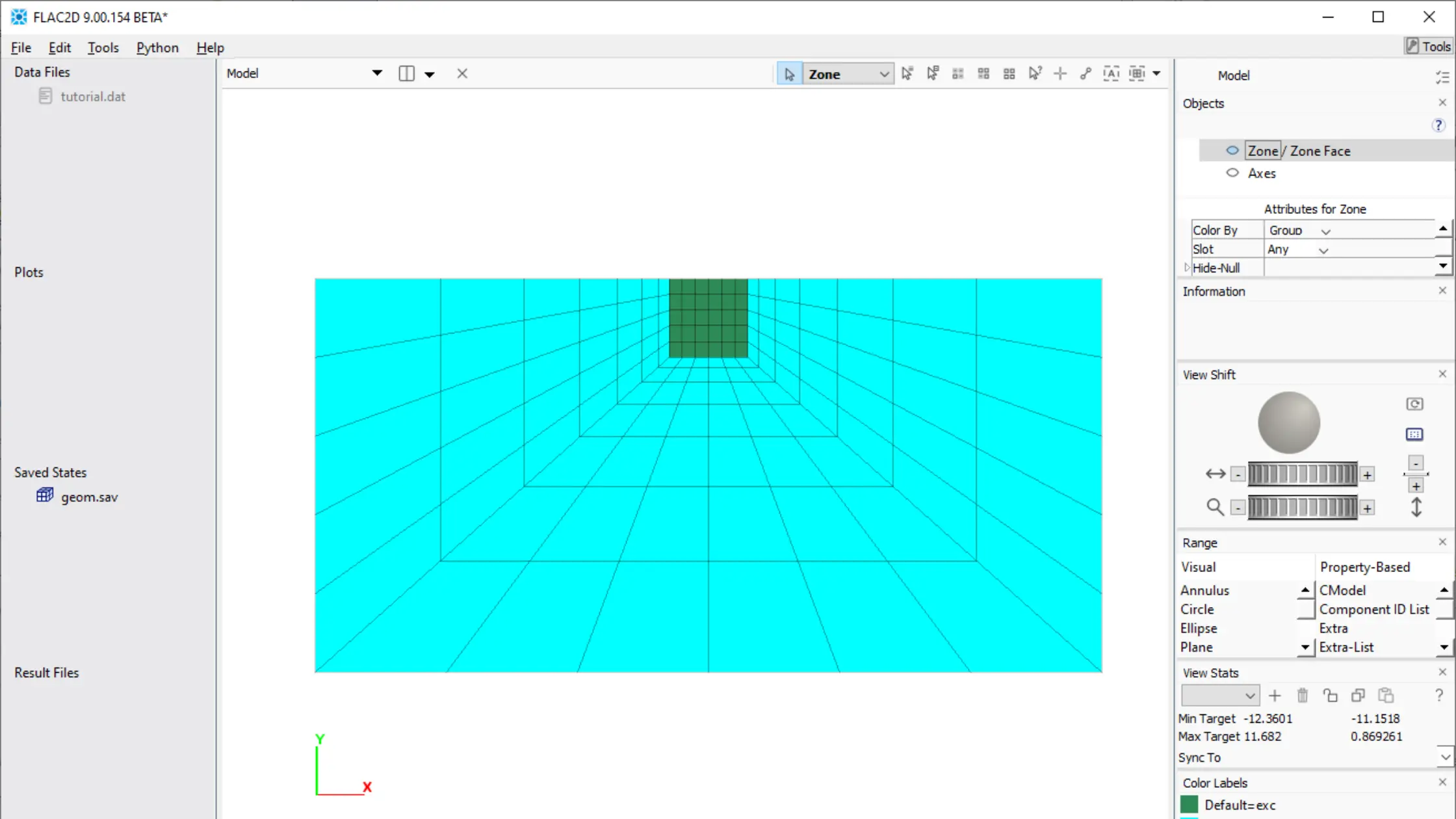
FLAC software is built to simulate the mechanical behaviors of soil, rock, and other geological materials. Engineers, geologists, and researchers rely on FLAC software to make critical design decisions before any physical ground disturbance takes place.
FLAC 2D vs FLAC 3D Software
- FLAC 2D — plane-strain and axisymmetric problems, tunnel cross-sections, uniform geometry
- FLAC 3D software — full three-dimensional modelling, complex underground mines, irregular excavations, problems varying in all three spatial directions
- When to choose one over the other
What is PLAXIS Software?
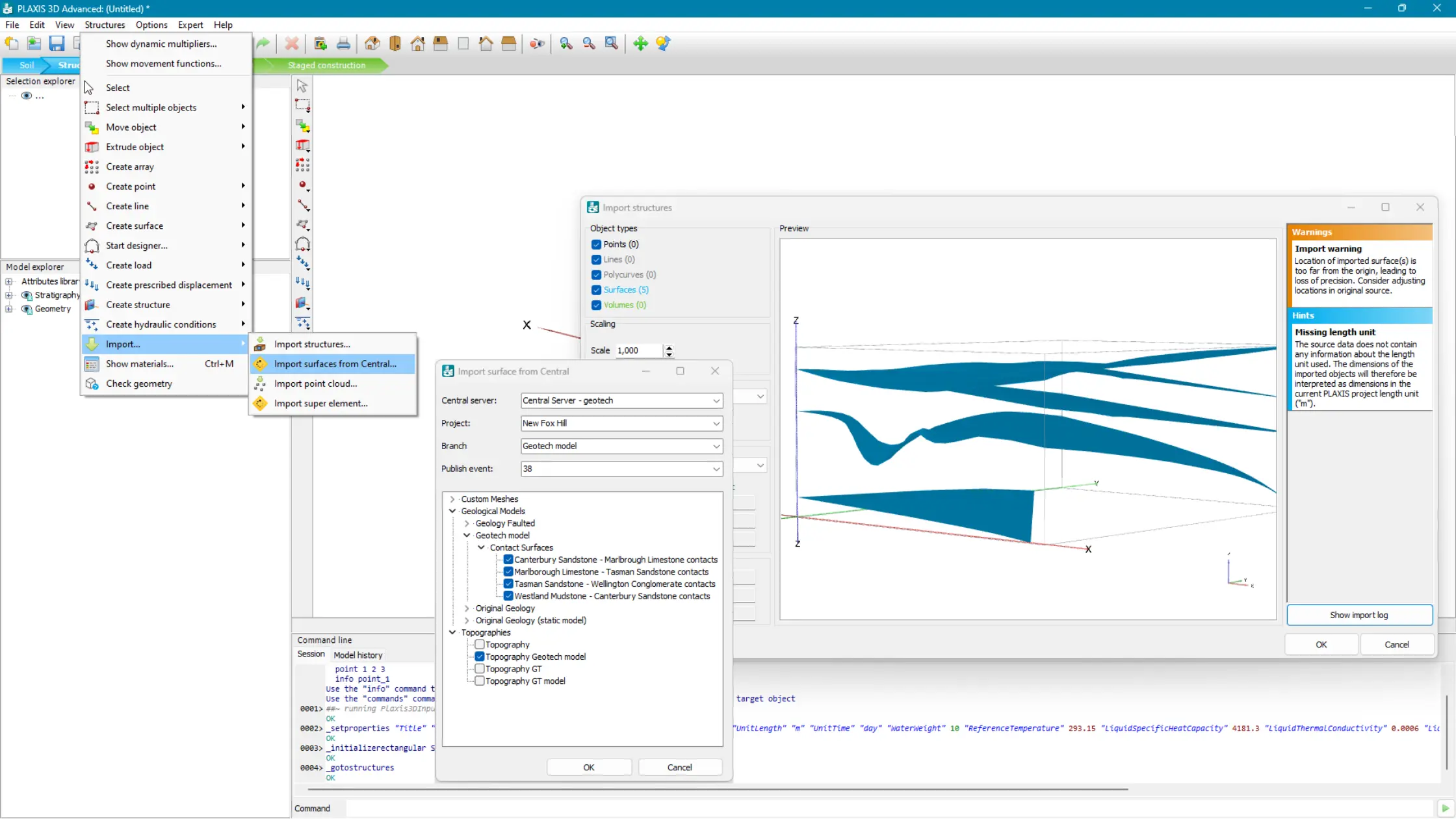
PLAXIS geotechnical software is a premier finite element analysis (FEA) built for the analysis of subsurface environments in civil, mining, and environmental engineering projects.
At the heart of any PLAXIS simulation is the PLAXIS model, which is a structural representation of the ground, structures, loading, and boundary conditions that together define a geotechnical problem.
PLAXIS 2D Software Vs PLAXIS 3D Software
PLAXIS 2D Software
- PLAXIS 2D software is designed to help solve many geotechnical problems that can be represented through a two-dimensional cross-section. It is widely used at the time of plain- strain and axisymmetric conditions, which helps cover routine geotechnical consulting and design work.
PLAXIS 3D Software
- PLAXIS 3D extends the same implicit finite element accuracy of PLAXIS 2D into full three-dimensional space. It is designed to study the geometrical problems that arise when loading or ground conditions vary significantly in all three spatial directions
PLAXIS vs FLAC Software: What is Better in Comparison?
- Accuracy and Stability
FLAC software uses explicit finite difference methods, which make it highly stable for large deformations in post-failure analysis. FLAC 3D software excels in modelling progressive collapse and creep.
PLAXIS geotechnical software uses the implicit finite element method. It models hardening soil, soft soil creep, and NGI – ADP, which helps produce highly accurate stress deformation.
Here, FLAC wins because of post failure and large deformation, and PLAXIS wins because of serviceability accuracy and material diversity.
Best Use Case
FLAC software geotechnical applications outshine in mining geomechanics with rock burst modelling and time-dependent ground behaviors. FLAC 2D and FLAC 3D software stand as the standard in underground mine design globally
- Ease of Use
PLAXIS 2D software and its documentation, specifically the PLAXIS 2D manual, are widely praised for their intuitive CAD-based model-building capabilities. The PLAXIS model workflow (Soil ? Structures ? Mesh ? Staged Construction) is structured for rapid onboarding. PLAXIS Bentley’s Virtuoso Subscription bundles training directly with the license.
Choose FLAC software when:
Itasca Consulting Group was developing FLAC software. It is built on an explicit finite difference method that makes it uniquely powerful in specific, demanding scenarios.
Here is exactly when FLAC is your most reliable engineering choice.
- Modeling Collapse or Progressive Failure
When your project involves ground that undergoes collapse, plastic flow, or step-by-step deterioration, FLAC software helps deliver results that implicit FEM tools simply cannot match.
FLAC software geotechnical users mainly rely on the capability for embankment failure analysis, retaining wall collapse under surcharge, and strain-softening slopes where the peak strength surface progressively degrades.
- Analyzing Dynamic or Seismic Problems
Dynamic loading in earthquakes, blasting, pile driving, and machine vibrations introduces wave propagation phenomena that require precise, time-domain solutions. FLAC software handles these through its dedicated Dynamic Analysis module, which supports time-history input, wave-absorbing (quiet) boundaries, and Rayleigh damping, all critical for accurate seismic site response modeling.
- Working in Mining or Underground Excavation
No domain relies more heavily on FLAC than underground mining. From open-pit bench design to deep underground stope stability, FLAC 3D software is a globally recognized standard for mine geomechanics.
FLAC software geotechnical mining applications also benefit from Itasca’s dedicated Bench Blast Design and Explosive Rock Interaction tools embedded within FLAC 3D software helps enable engineers to predict rock fragmentation zones, vibration propagation distances, and energy distribution from individual blast events. For tunnel engineers, FLAC 2D provides rapid cross-sectional analysis of lining loads and convergence under sequential excavation stages.
Read More: PLAXIS Software in Geotechnical Engineering: A Complete Overview
Choose PLAXIS geotechnical software when:
PLAXIS geotechnical software is distributed globally by Bentley, which is built on an implicit finite element method that makes it the preferred choice for serviceability-driven, structure-sensitive, and academically rigorous geotechnical projects.
Here’s when you should choose PLAXIS
Performing Foundation Settlement Studies
Settlement prediction is one of the most consequential calculations in geotechnical engineering, and PLAXIS geotechnical software is uniquely equipped to handle it with precision. Its implicit finite element solver accurately computes both immediate elastic and time-dependent consolidation settlements, capturing the full deformation history of loaded soil from initial loading through long-term primary and secondary compression.
- Difference between PLAXIS Model and FLAC Model
Learning about how each platform builds and solves its model is fundamental to choosing the right tool for your project. The PLAXIS model and the FLAC model are architecturally different from the ground up, and that difference directly determines what each tool can and cannot do reliably.
The PLAXIS 2D/3D Model
The PLAXIS 2D model is built on triangular finite elements assembled through a structured, GUI-driven mesh workflow. PLAXIS 2D software automatically generates high-quality meshes directly from CAD geometry, making model setup fast, mesh refinement intuitive, and result validation straightforward.
Best for: FEM accuracy, serviceability analysis, GUI-driven workflows, and academic or consultancy projects with two-dimensional geometry.
The PLAXIS 3D model extends the same implicit finite element foundation into full three-dimensional space using tetrahedral mesh elements. It handles spatially varying geometry, three-dimensional loading conditions, and complex staged construction sequences that a 2D cross-section cannot represent without significant loss of accuracy.
Best for: Pile groups, 3D consolidation, offshore structures, irregular excavations, and BIM-integrated project environments.
The FLAC Model
The FLAC model is very structured around zones and gridpoints which is solved through an explicit finite difference time-stepping scheme. Compared with the GUI-driven PLAXIS model, the FLAC model is primarily constructed and controlled through scripting using Itasca’s FISH programming language, which gives engineers precise control over every aspect of model behavior material response, boundary conditions, loading sequences, and output extraction.
This architecture makes FLAC software uniquely stable when modeling plastic flow, large deformation, and post-peak material behavior scenarios where implicit FEM solvers can struggle to converge or produce physically meaningful results. The explicit time-stepping approach does not require global matrix assembly or convergence iteration, which is precisely why FLAC software remains the tool of choice when the ground is expected to fail, flow, or deform beyond the elastic range.
Best for: Plastic flow, progressive failure, large deformation, dynamic analysis, and mining geomechanics
Conclusion
Both PLAXIS and FLAC are globally validated tools. The PLAXIS and FLAC are extensively referenced in peer-reviewed geotechnical research, covering slope stability, deep excavation, and soil-structure interaction.
The right choice depends not on quality, but on problem type. Serviceability and FEM accuracy favour PLAXIS geotechnical software, while large deformation and failure mechanics favour FLAC software.
At PIGSO LEARNING, you can gain practical experience with advanced geotechnical simulation tools through structured training programs designed for engineers, researchers, and consultants. If you are looking for a Plaxis training course online, PIGSO LEARNING provides hands-on guidance with real engineering simulations and practical case studies.
FAQs
Is PLAXIS 2d enough for most projects?
Yes, PLAXIS 2d software assists in covering major routine geotechnical projects examples retaining walls, embankments, foundations, and tunnels.
What is the difference between FLAC 2D and FLAC 3D?
FLAC 2D solves plane-strain and axisymmetric geotechnical problems, ideal for uniform cross-sections. FLAC 3D software models full three-dimensional geometries is essential for complex underground mines, irregular excavations, and problems where geometry varies significantly in all three spatial directions.
Where can I learn about FLAC software?
You can learn FLAC software at PIGSO LEARNING, where you get hands-on training from professionals.
Is online learning for PLAXIS available?
Yes, you can learn about PLAXIS software via online mode. Check out PIGSO learning platform where you can learn about PLAXIS software at your own time, at your own pace. You get a hands-on learning experience with professional academicians and get a chance to learn from real-world case studies.
.

Simran Shekhawat is an experienced SEO content writer with three years of hands-on experience in crafting high-impact digital content. With a strong command of search engine optimisation practices, she specialises in creating content that not only reads well but also ranks effectively. Her expertise encompasses keyword research, topic clustering, on-page SEO, content strategy, and crafting copy that aligns with both user intent and brand objectives.
Comments are closed